
By Yishuang Shi, University of Glasgow postgraduate MSC Museum Education student, supporting the Audubon project school engagement project with Anderston Primary January – March 2026
During my placement at the Royal College of Physicians and Surgeons of Glasgow, one particularly significant area of learning has been how heritage collections can be transformed into public-facing educational practice, especially for children. The Audubon education partnership developed with Anderston Primary School offers a strong example of how rare books, environmental education, artistic practice and community collaboration can be brought together in a meaningful way. According to the project plan, this is a ten-week interdisciplinary programme, supported by College staff and artist Helen Kellock, with sessions mainly taking place at the school on alternate Tuesday mornings and concluding with a presentation of pupils’ work and a book launch.
The project takes John James Audubon’s The Birds of America as its central point of inspiration. However, the work is not treated simply as a rare and valuable historical object. Instead, it is used as a teaching resource within an interdisciplinary learning framework. According to the project plan, the programme integrates Science, Literacy and Art, making direct links to the Scottish Curriculum for Excellence, targeting local Primary 6 pupils aged 10-11 at Anderston Primary School. It introduces scientific topics such as classification, species characteristics, adaptation and extinction, while also developing skills in non-fiction writing, information organisation, close observation and artistic expression through different media. The learning aims include helping pupils identify and classify living things, understand why some species survive while others become extinct, and communicate their observations and research through both language and image.
In structure, the project is not a single visit or short workshop, but a carefully sequenced educational process. Beginning with Audubon’s bird imagery, it combines observation, scientific understanding and creative practice, gradually guiding pupils from looking at historic collections to researching local birds and producing work rooted in Glasgow’s own natural environment. The project title, A Glasgow Bird Book, inspired by Audubon’s Birds, makes clear that the aim is not only to introduce Audubon, but to use his work as a starting point for pupils to develop their own understanding of local birds, ecosystems and environmental relationships.
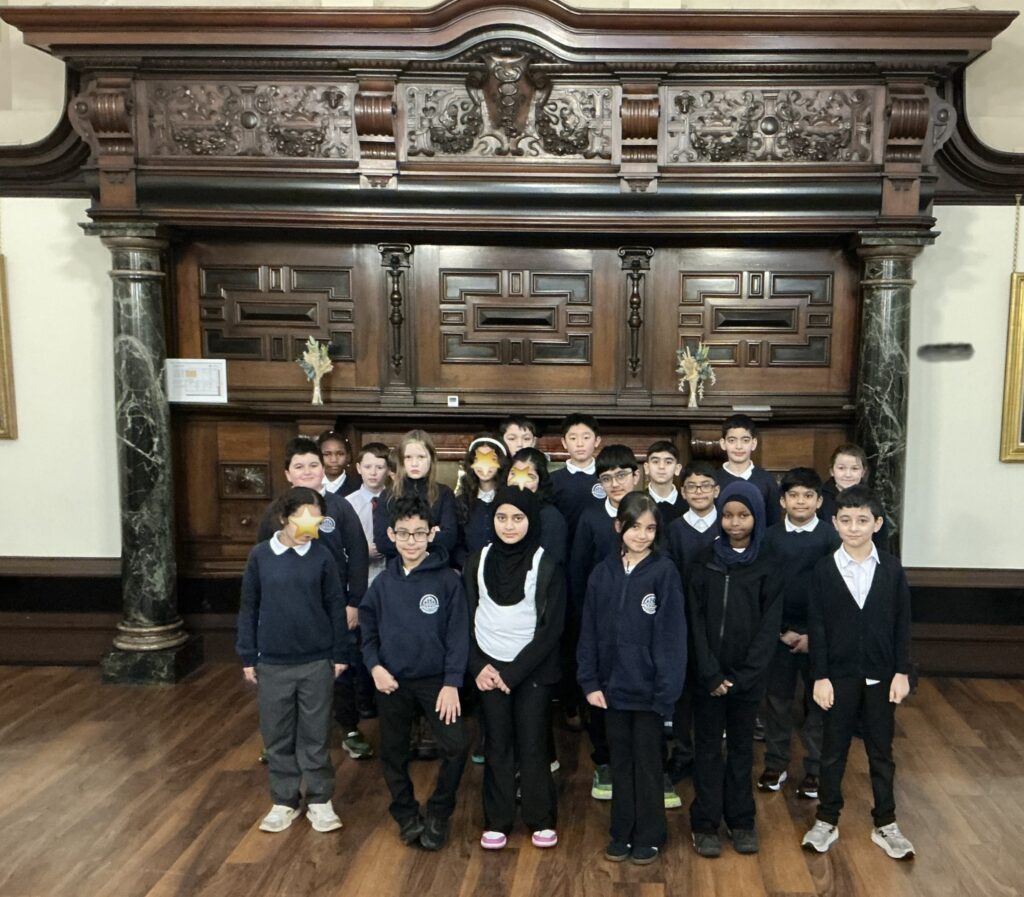
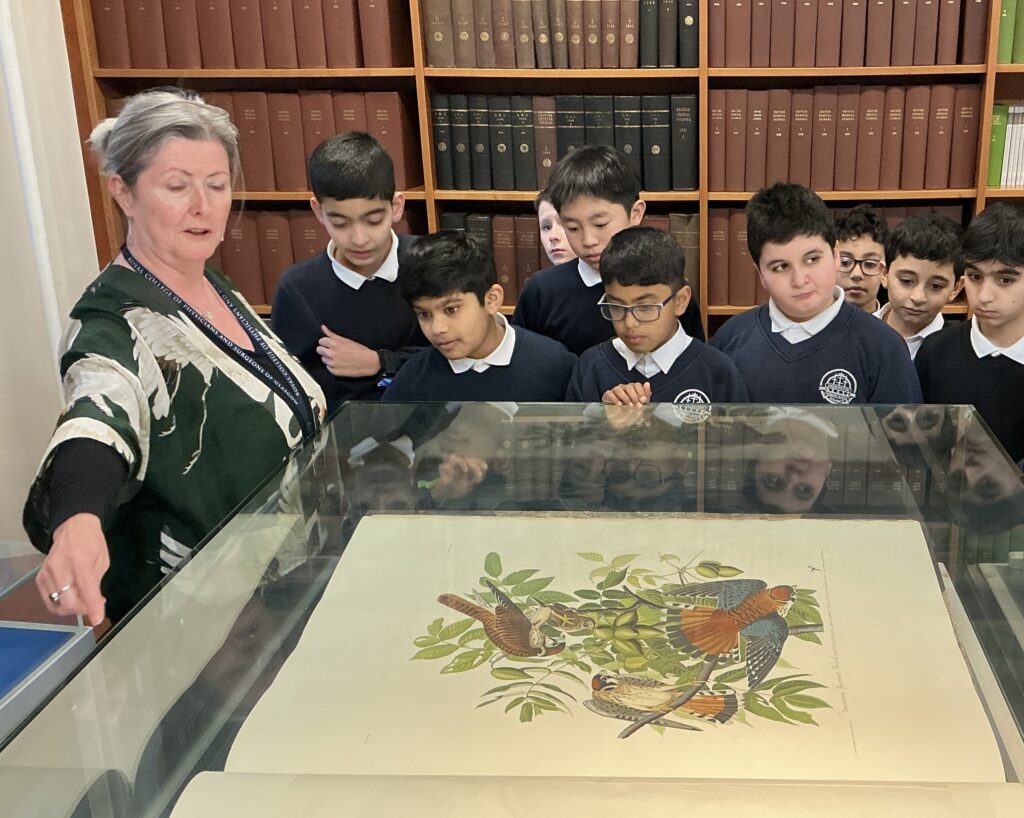
The first session took place at the Royal College itself, on St Vincent Street in Glasgow City Centre. According to the session plan, pupils began by visiting the College spaces and entering the library, where they encountered the relevant books and were introduced to Audubon and his work. This first stage focused on the shared importance of observation in both science and art. The session concluded with the making of a paper bird decoration, allowing pupils to respond creatively to the theme through a hands-on activity. Evaluation materials also show that this initial visit centred on visiting the College, seeing the “big bird book”, learning about birds and taking part in art-making.
The second session focused on the question of why there are so many different kinds of birds, with particular attention to flight and natural adaptation. Starting from Audubon’s representation of 489 North American birds, the lesson used comparison, discussion and games to help pupils understand why bird life is so diverse. The session plan explains that flight allows birds to cross seas and continents, access different resources, escape ground predators and gradually develop different beaks, wings and feet suited to particular environments and functions. The accompanying art activity used watercolour and silhouette collage to explore the visual idea of birds in flight, linking scientific concepts with creative interpretation.
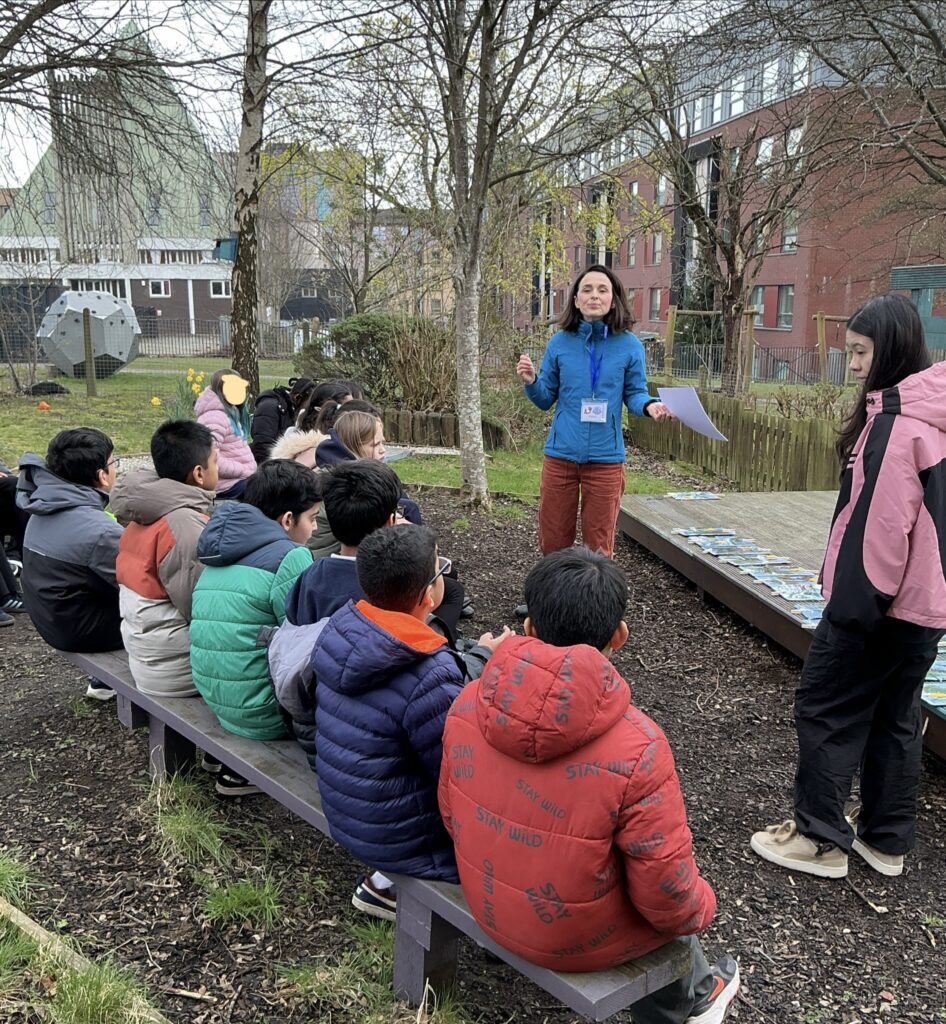
The third session turned to the question of why birds matter, extending the discussion to the kinds of birds that live in the pupils’ own surroundings. Here the main concepts were ecosystems and biodiversity. Pupils were introduced to the many roles birds play in the environment, including pest control, seed dispersal, pollination, scavenging, nutrient cycling and support for ecological balance. They then went outside into the school grounds to observe birds, plants and other wildlife, making records of what they saw and collecting leaves to bring back into the classroom. The creative response took the form of leaf printing and collage, producing work that reflects the interdependence between birds and their environments.
The fourth session focused on the question of why birds have such striking feathers, and introduced scientific illustration. Drawing on Audubon’s images, the lesson explored the functions of feathers in flight, insulation, waterproofing, camouflage, sexual difference, age difference and display. It also introduced the idea of scientific illustration as an important historical means of recording species and communicating knowledge before photography became widely available. Pupils were asked to study feathers closely from several angles, paying attention to size, colour, texture and shape, and then to complete blind drawings, line drawings and watercolour studies. This session particularly emphasised close looking as a skill shared by both scientific inquiry and artistic practice.
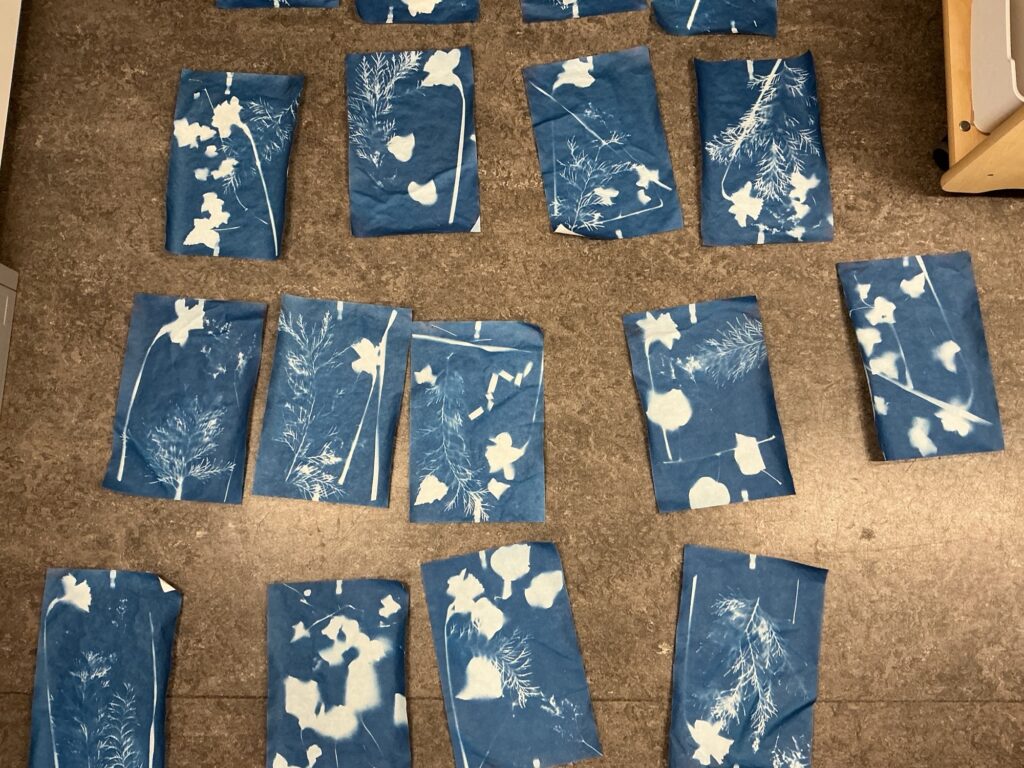
The fifth session extended the project from birds to plants and foliage, with a focus on composition and cyanotype. The session plan notes that Audubon studied plants carefully as well as birds, and incorporated botanical elements into the composition of his images. This lesson therefore returned to biodiversity and to the ecological value of birds, while also asking pupils to consider which plants in the school environment provide food or shelter for birds and other forms of wildlife. In the practical component, pupils used natural materials collected from the school grounds to experiment with composition and create cyanotype prints, linking environmental observation with image-making and material exploration.
My placement ended on 24th March but the sessions with Anderston Primary School will continue running until June. I have included a summary below, of the plan for these sessions:
The sixth session will shift the learning environment from the school to the nearby Kelvingrove Museum and Art Gallery and introduces the theme The Birds of Anderston. This lesson connects Audubon’s bird imagery with the idea of extinction. Pupils will observe extinct birds such as the dodo and the Great Auk at Kelvingrove and draw from museum specimens. Each pupil will then be assigned a bird to research in more depth, which will become the focus of the following two sessions. If time allows, the session also includes a short bird-spotting walk back to the school.
The seventh session will continue The Birds of Anderston theme, now concentrating on the challenges facing these birds. At this stage, the project revisits extinct birds represented in Audubon’s work and introduces information about the current condition of birds in Britain, helping pupils consider conservation, habitat and environmental pressure in contemporary terms. Pupils research their chosen bird further, gathering information about habitat, migration, conservation status and food sources. On the basis of this research, they produce a scientific line drawing that combines the bird with plant elements from its environment. This marks a clear shift in the project from observation toward sustained research and interpretation.
The eighth session is the final art-making stage, titled The Birds of Anderston – final work for book. In this lesson, pupils return to Audubon’s paintings and prints, observe aspects of his style and method, and use the line drawing from the previous session as the basis for a final watercolour painting. The purpose here is no longer simply to practice a technique, but to create a finished work that will form part of the final book.
The ninth session returns to the Royal College for the book launch. The project timetable shows that pupils will revisit the College in order to celebrate the completion of the project and present their work. The final pupil evaluation also lists this explicitly as “Book launch at the Royal College”, showing that the project begins with an introductory visit to the College and ends by returning there for a public presentation of outcomes. This creates a coherent and carefully framed educational arc.
My placement involved more than observing the Audubon programme itself, and developed through several connected stages, from research to delivery support and activity design. I began with research into related projects at other museums, particularly in the areas of nature education, children’s engagement and exhibition-based public programming, in order to understand how similar initiatives are often developed around collections and themes. This was followed by practical involvement in the first five sessions of the Audubon programme, from January to March, supporting artist Helen Kellock during classroom discussion and hands-on making activities, especially by helping children who needed additional explanation or encouragement in order to participate fully. This made it possible to see more clearly that the success of an educational project depends not only on thoughtful planning, but also on flexible and responsive support during delivery.
In addition to supporting the sessions, the placement also involved thinking about how the Audubon project might be extended into the College Library. Drawing on both the initial research and the specific context of the Audubon exhibition, I developed a number of simple and practical public activity ideas for possible future use in the Library. These included bird colouring activities, label card design, hanging displays, postcards, collage activities and origami, all intended to be low-threshold, easy to implement and suitable for different age groups. This strand of the placement suggested that the project could continue beyond the school setting and be developed further within the Library and exhibition space as a form of wider public engagement. Taken together, the placement offered a fuller understanding of how a museum learning project develops from research and observation to early-stage design, while also highlighting the connections that can be built between heritage, school education and public participation.
Through this placement, my understanding of museum education projects became much more concrete. It can be easy to think of museum education mainly in terms of the delivery of activities themselves, but this experience showed that a project is often a connected whole, involving initial research, session planning, on-site delivery, responses from children, and the extension of ideas into future public activities. The Audubon programme in particular demonstrated that heritage collections only become meaningful learning resources for children and wider audiences when they are carefully translated into accessible and engaging experiences. Observing how Helen structured activities and responded to children’s reactions also made it clearer that educational work requires not only a clear framework, but also flexibility and responsiveness in practice. At the same time, thinking about possible library activities further showed that public engagement does not always depend on complex formats; simple, practical and low-threshold activities can also be highly effective in bringing audiences closer to collections.
Taken as a whole, the full sequence of sessions reveals a clear developmental structure. The first stage introduces pupils to the College and to Audubon’s work; sessions two to five expand into themes of flight, adaptation, ecosystems, feathers, plants and composition; sessions six to eight develop these ideas into focused research on local birds, scientific drawing and final creative production; and the final session culminates in a shared public outcome through the book launch. Across the programme, scientific knowledge, local environmental observation, artistic technique and public expression are brought together in a way that helps pupils not only learn about birds, but also learn how to observe, record, organise information and communicate understanding through visual form.
The project’s evaluation framework further demonstrates the breadth of its educational aims. The final pupil evaluation lists all nine sessions and asks pupils to reflect on what they remember, what they learned and which parts they most enjoyed. The learning outcomes include being able to identify more birds, understand why birds matter, learn about adaptation, observe more carefully like a scientist and an artist, experiment with new artistic techniques and gain confidence in making art. The work pupils are invited to feel proud of corresponds directly to the different stages of the programme, including the hanging winter bird, silhouette bird artwork, leaf print and collage, feather drawing, cyanotype print, Kelvingrove bird drawings, scientific line drawing, final watercolour painting, and the completed book and launch event. This suggests that the programme values not only knowledge acquisition, but also confidence, process, observation and creative achievement.
Beyond the school sessions, the project also connects with broader public engagement through activities designed for the Audubon exhibition in the College Library. These include colouring sheets, museum label cards, hanging bird displays, bird postcards, build-a-bird collages and origami birds. The aim of these activities is to encourage low-threshold participation by exhibition visitors and to build shared outcomes such as a “community flock” or “community bird wall”. This shows that the Audubon project is not limited to school-based teaching, but also resonates with the Library’s wider exhibition and community engagement work.
Overall, the Audubon education partnership demonstrates how the Royal College of Physicians and Surgeons of Glasgow brings together rare books, exhibitions, school learning and community participation in ways that transform collections from static holdings into active educational resources. Through a long-term, phased and interdisciplinary structure, pupils move from viewing Audubon’s bird imagery to developing their own understanding of local birds, ecosystems and environmental issues, and finally to responding through research and creative work of their own. As such, the project offers a vivid example of how heritage, art and environmental education can intersect in contemporary museum and school practice.
The Maximising Audubon Project at the Royal College of Physicians and Surgeons of Glasgow
This project is part of the Maximising Audubon project supported by Museums Galleries Scotland. It aimed to widen awareness, understanding of and access to our Audubon collections. A new exhibition about our double elephant folio sized first edition volumes of JJ Audubon’s The Birds of America (1827-1838) launches in 2026 https://heritage.rcpsg.ac.uk/exhibits/show/audubon-birdsofamerica
The project enabled us to carry out conservation work on both volumes and also photograph them. We have also been able to work with an expert retail professional to develop a brand-new line of retail products linked to Audubon’s work. Finally, this funding allowed us to develop the community engagement programme with local school children at Anderston Primary and with the GAMH Community Hub, based at Flourish House in the Woodlands area of Glasgow, a mental health recovery space which hosts a number of groups and projects. The RSPB have also supported our work with community groups and carried our bird identification training with us.
Additional funding for conservation work was provided by the Baillie’s Institution.