
by Daniil Vasiukova, Heritage Volunteer
Exploring the links between two great men through their lives and work
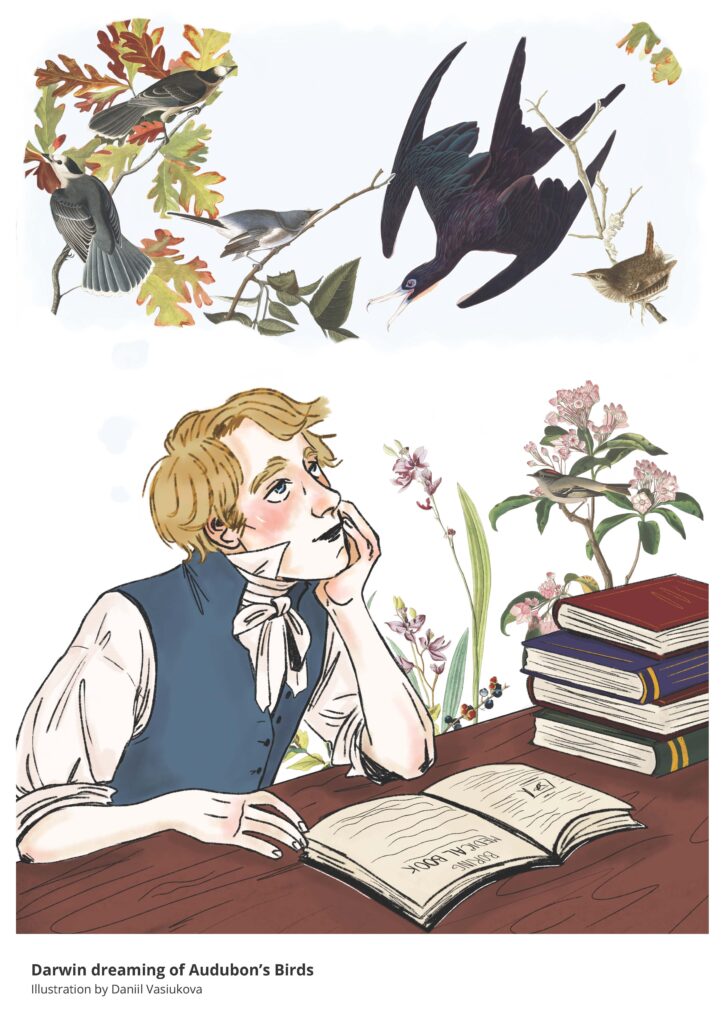
When John James Audubon came to Britain in 1826 seeking a printer and patrons for his great work, ‘The Birds of America’, he quickly became the star of the scientific world. He soon acquired many famous and influential friends, patrons and admirers thanks to his great talent and charisma. Among his admirers, the name of Charles Darwin is particularly intriguing. Although he now surpasses most of Audubon’s admirers in influence, fame and legacy, in 1826 Darwin was a young and complete unknown.
The first edition of Darwin’s ‘On The Origin of Species’ is one of the treasures of the Royal College of Physicians and Surgeons’ Library collection. The book was published in 1859, eight years after Audubon’s death, yet the famous ornithologist is mentioned in it three times. What merited such an honour?
When I started looking for the answer to this question, I wasn’t expecting to uncover a wide net of connections between the two men. It turned out that although Audubon and Darwin never talked to each other, they had more in common than meets the eye. I have always been interested in Darwin and find it quite incredible that a man who most people imagine as an old and wise scientist with a big beard, made most of his groundbreaking discoveries as a young adult in his 20s. During my research, I found a wonderful essay; ‘Darwin’s Audubon’ by Gerald Weissmann (2002), that was particularly helpful in uncovering the many connections between the two great men.
Edinburgh – the medical capital of the world
Their paths first crossed in Edinburgh. In 1825, a sixteen year-old Charles came to the city to study medicine at the University of Edinburgh. Both Darwin’s father and grandfather were doctors, and his father wished that his son would continue the family tradition. As Darwin remembered in his autobiography, “my father… declared that I should make a successful physician… but what he saw in me which convinced him… I know not” (‘The Life and Letters of Charles Darwin’, ed. F. Darwin, 1887). Darwin hated the dull lectures, and was more interested in curious rocks than human bodies. Above all, he was horrified by the sight of blood and suffering of the pre-anaesthesia medical practice, rushing out of the operating theatre during a particularly gruesome operation. Darwin found comfort in natural history societies and, as a member of the Wernerian Society of Natural History, attended a lecture on American birds given by Audubon in 1826. During the lecture, Audubon described the turkey vulture bird that is set to “devour the young of many species and cannibalize their own” (quoted in Darwin Audubon, G. Weissman). It must have made a strong impression on Darwin, a reluctant medical student, revolted by the sight of blood. This was the only time Darwin saw Audubon in person.
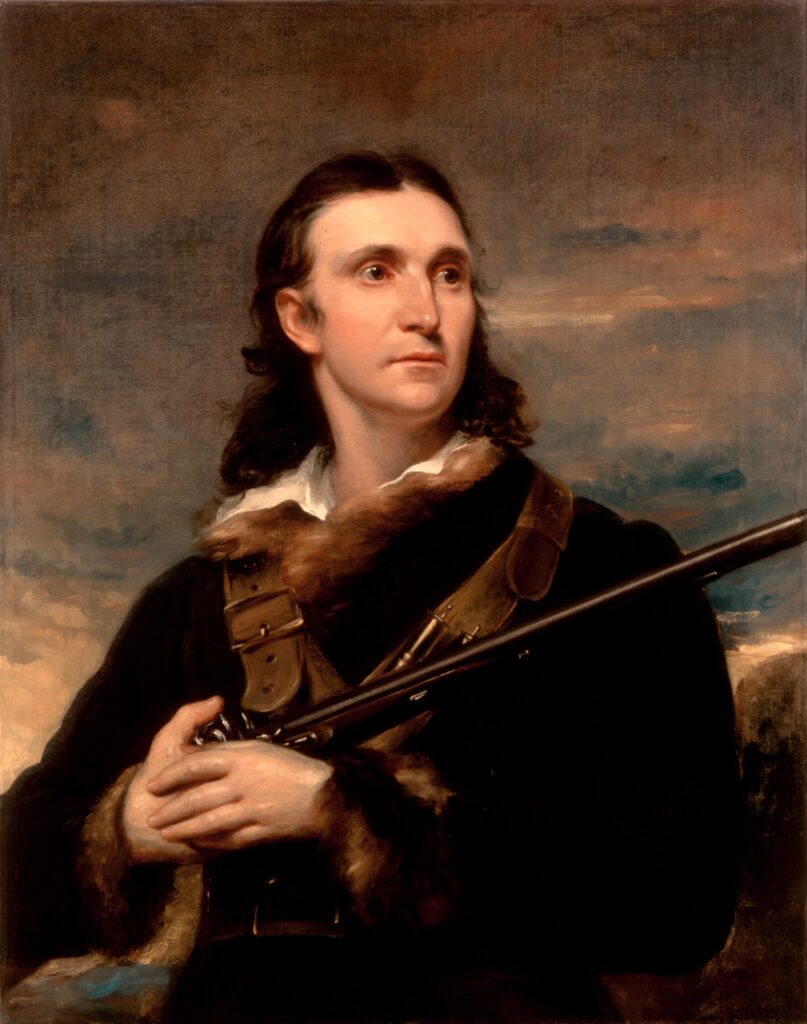
John James Audubon by John Syme, 1826.
Oil on canvas. White House Collection
Further neglecting his medical studies, Darwin preferred to socialise with naturalists. One of his friends and mentors was the Scottish naturalist and ornithologist William MacGillivray, who, in 1823, had become an assistant to Robert Jameson, the professor of Natural History at the University of Edinburgh. In 1831, MacGillivray became the curator of the museum of the Royal College of Surgeons of Edinburgh. MacGillivray was also a close friend of Audubon and helped him write and edit large portions of his ‘Ornithological Biography’, the text that accompanies the plates of Audubon’s ‘The Birds of America’. In a way, MacGillivray can be considered a co-author of the book. In gratitude, Audubon named a finch after his friend. Thus, in Edinburgh Darwin met both authors of the ‘Ornithological Biography’.
During his stay in Britain, Audubon wrote detailed letters to his wife, Lucy, who had spent her childhood in England before moving to America with her family. Shortly after giving the lecture on the turkey buzzard, Audubon left Edinburgh and arrived in Matlock, Derbyshire, to honour his wife’s English roots by visiting a grave of her family friend and physician — Erasmus Darwin, Charles Darwin’s grandfather. Erasmus was a leading figure of the British Enlightenment, and Audubon admired him as a fellow naturalist and the author of the famous ‘Zoonomia’, a great encyclopedic work on medicine and nature. Charles Darwin, however, didn’t hold his grandfather in equally high regard, quoting him only once in the ‘On The Origin of Species’.
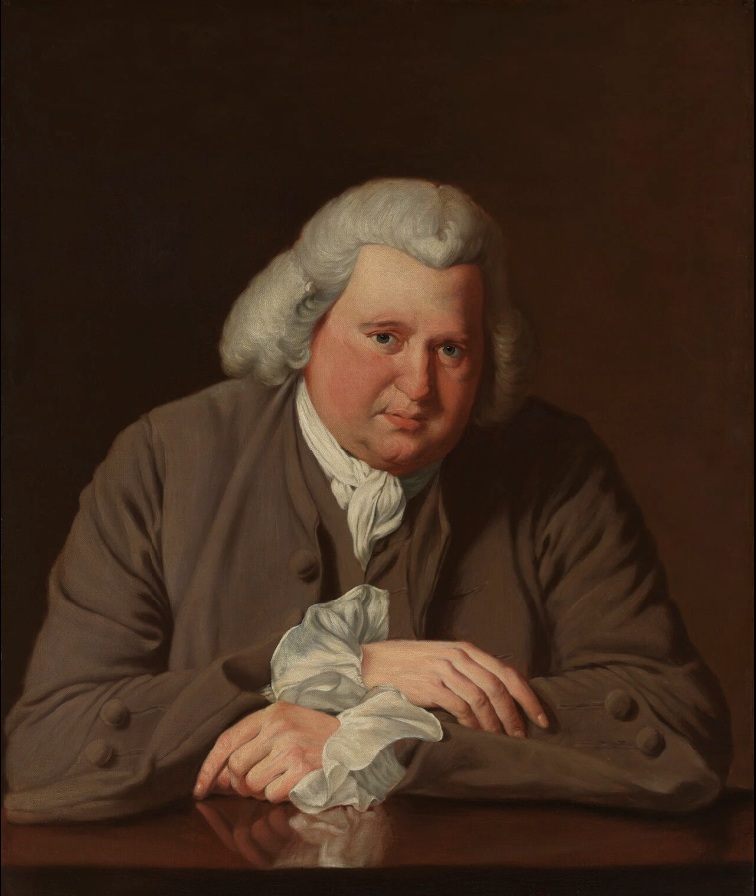
Erasmus Darwin after Joseph Wright
Oil on canvas, based on a work of probably 1770s. National Portrait Gallery
Darwin’s father wasn’t happy with his son’s lack of medical progress, and in 1828 sent him to Cambridge in the hope that he might become a parson. There, he met John Stevens Henslow, Professor of botany. The two became so close that Darwin was known at the university as “the man who walks with Henslow” (”The Life and Letters of Charles Darwin’, ed. F. Darwin). Henslow was a true Renaissance man and a central figure at Cambridge at the time, but today he is best known as a friend and mentor to Charles Darwin. In 1831 he recommended the twenty-two year old Darwin as a naturalist companion to Robert Fitzroy, the captain of the survey ship HMS Beagle, on a two year voyage to survey South America.
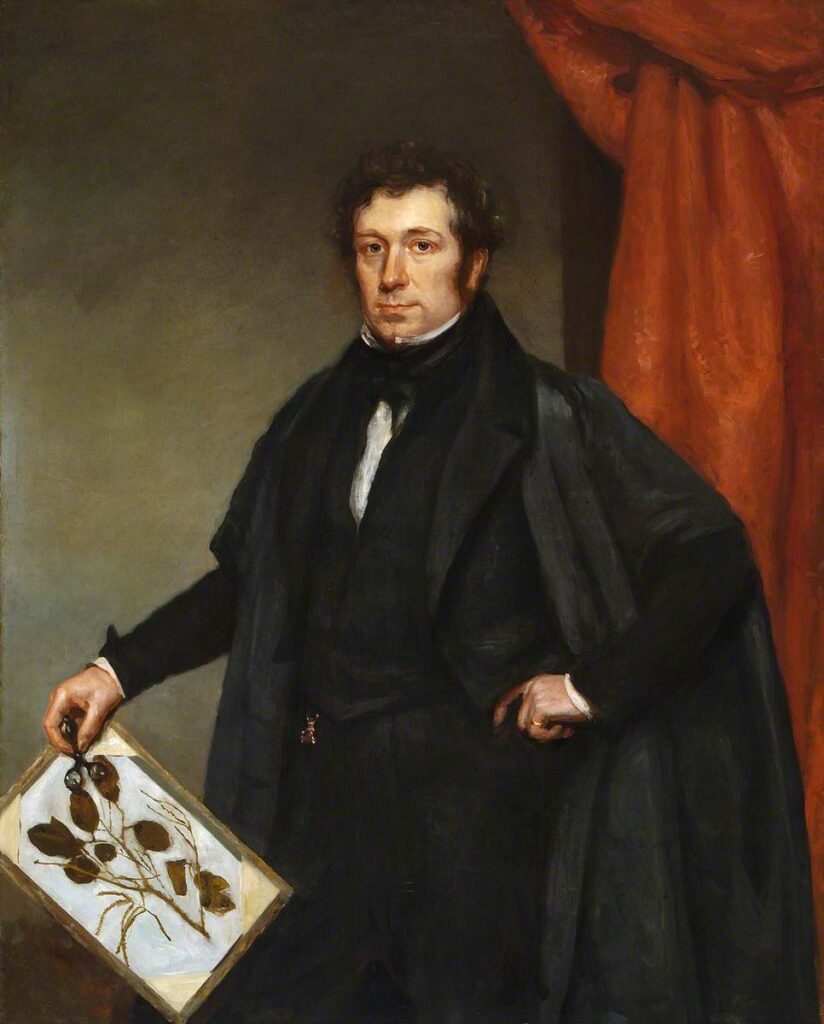
John Stevens Henslow, Unknown artist
Henslow, in 1828, had been among the professors who welcomed Audubon when he visited Cambridge. Audubon was so impressed with the university that he wrote to his wife, “My Lucy, that I also had received a university education!” (quoted in ‘Darwin’s Audubon’, G. Weissman). Henslow later convinced the Cambridge University Library and the Philosophical Society to acquire the complete set of Audubon’s double elephant folio of ‘The Birds of America’. It was a substantial commitment of the university’s funds. In gratitude, Audubon immortalised Henslow in natural science, naming a bird after him; ‘Henslow’s Bunting’. The two corresponded for several years.
In the late 1820s, Darwin was still unsure about his future, meanwhile Audubon enjoyed the fame and recognition that by then had reached Europe. In 1828, he was introduced to the French Academy of Sciences by Georges Cuvier, a leading naturalist and pioneer of paleontology. Cuvier described ‘The Birds of America‘ as “the greatest monument yet erected by Art to Nature” (quoted in ‘Darwin’s Audubon’, G. Weissman). In turn, Audubon paid his respects to Cuvier by naming a kinglet after him. Despite Cuvier’s great achievements, he was a complex figure. He was one of the early supporters of the theory of scientific racism and a fierce opponent of evolutionary theories. Twenty years after Cuvier’s death, Darwin disputed Cuvier’s ideas about evolution and extinction. Like Audubon, Cuvier is mentioned in ‘On the Origin of the Species’ three times.
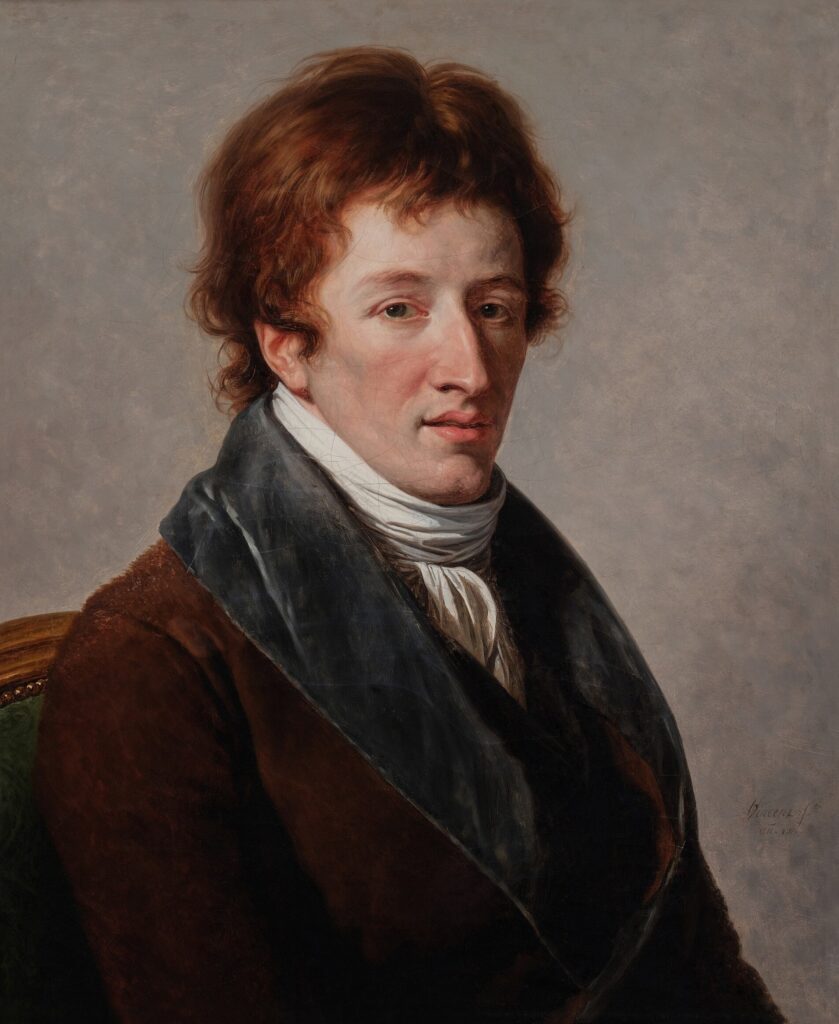
Georges Cuvier by François-André Vincent c.1800
The one Audubon bird that had the most influence not just on Darwin but, perhaps, on natural science in general, was the magnificent frigate-bird. “No one except Audubon has seen the frigate-bird… …alight on the surface of the ocean”, Darwin writes in ‘On the Origin of Species’. It is with this bird and its webbed feet still in mind that Darwin enunciates the theory of natural selection in the very next paragraph:
“He who believes in the struggle for existence and the principle of natural selection, will acknowledge that every organic being is constantly endeavouring to increase in numbers; and that if any one being varies ever so little, either in habits or structure, and thus gains an advantage over some other inhabitant or inhabitants of the same country, it will seize on the place of that inhabitant, however different that may be from its own place. Hence it will cause him no surprise that there should be geese and frigate-birds with webbed feet, living on the dry land and rarely alighting on the water.” (‘On the Origin of Species’, C. Darwin).
Could Audubon have imagined that his work might pave the way to the theory of natural selection when he was giving a lecture in Edinburgh? Could Audubon have known that the grandson of his hero, Erasmus Darwin, was in attendance? We don’t know, but the connection between the two demonstrates how impactful Audubon’s work turned out to be.
Fascinated by the connection between Audubon and Darwin, I turned my findings into a temporary display; ‘Darwin and Audubon: A Natural Connection‘. I hope the display will help people learn more about both Audubon and Darwin. As a Museum Studies graduate and a history enthusiast, I found working on this project exciting and rewarding. I am so grateful to the College for the support and guidance provided.
The exhibition ‘Darwin and Audubon: A Natural Connection‘ will be on display in the College Library April-June 2026. It accompanies the exhibition ‘The Birds of America by John James Audubon. A world treasure at the Royal College of Physicians and Surgeons of Glasgow‘ in the College Library, also from April 2026. It will feature our first edition of ‘On the Origin of Species’ by Charles Darwin alongside one of our first editions of JJ Audubon’s double elephant folios of ‘The Birds of America’.