

We’ve been delighted to once again host students from the University of Glasgow’s Scottish Literature department. The students were completing a placements as part of the course ‘Memorialising Scottish Literature and Culture’. The course encourages students to interpret a range of cultural materials and media in order to understand the construction of Scottish cultural memory.
This year we selected The Magnet (ref: DA 890.G5 RAD), a literary journal of four volumes published during the Glasgow Exhibition of 1888. A previous blog on the Magnet was written in 2013 but very little was known about it and we were unable to find any other existing copies We set the students the challenge of discovering who contributed to the journal and what they chose to write about.
We’re really grateful to the three students who took up the challenge. Thanks to them we now know that the authors were – James Findlay, William Findlay, John Frew, James Paterson, Robert Paterson, John Galloway Reid and JW Breslin. Here’s what else they found out…
‘The Magnet is that which has attractive properties’
Written by Anna Church, Poppy Jeffay and Anna McIlvaney
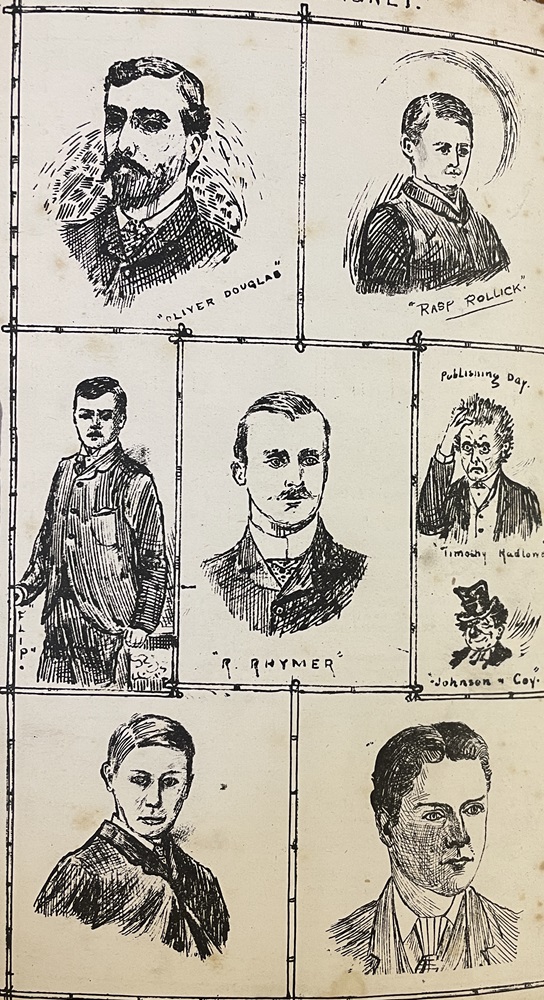
The Magnet is a journal consisting of four parts that were written and published over the course of four months in 1888 in Glasgow, ostensibly by a group of male friends. These men attached a variety of pseudonyms to their columns and sketches, and revealed their names in the final part. It is also revealed that four parts was all that was ‘originally intended’ (page 31) by the editors when they planned the journal, and so the page numbers carry over between each issue. The Magnet covers an array of topics, including a lengthy account of a fictional holiday, joke advice and editorials. The items that best pertain to the comedic and historical elements of the journal will be examined within this blog. Pictured below are portraits of the contributors to The Magnet.
The Characteristic Sketches
The Policeman
A rather wittingly charming section found in both part one and three of The Magnet, is the ‘Characteristic Sketches’ edited by William Findlay under the pseudonym Mr T Wilson Drake. This section comedically muses upon common stock characters of late nineteenth-century Glasgow, in part one focusing on ‘Policemen’ and ‘Young Ladies’ in part three. If we first take ‘The Policeman’ the characteristic sketch takes the form of a letter supposedly penned by the policeman himself who signs off ‘J. Pim’. The letter boasts of his ‘fairish good intelleck’ whilst seeming to care more dearly about the ‘ill-founded prejudice against us polismen smokin on dooty’.
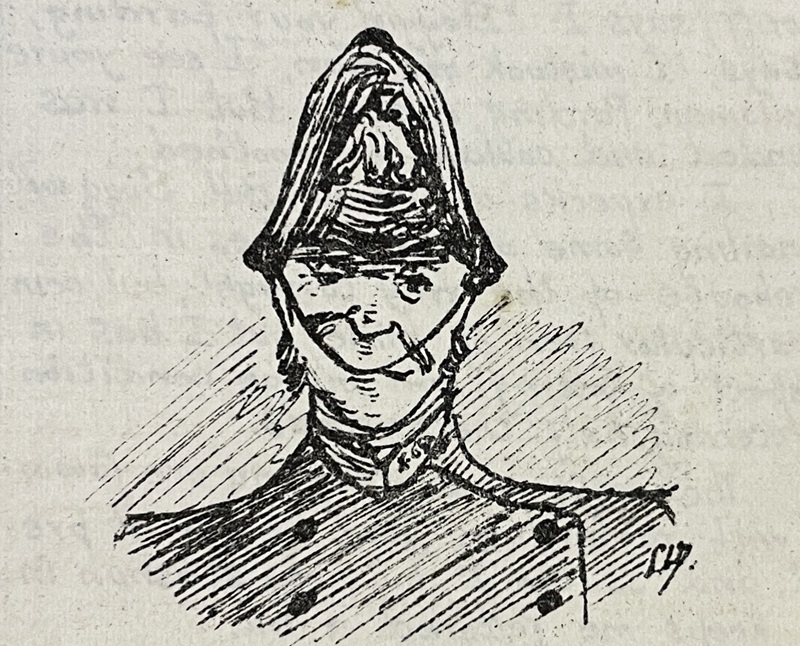
Findlay uses cacography to generate humour in this sketch, juxtaposing the policeman’s claims of intelligence with grammatical and spelling errors to undermine his character’s argument. Furthermore, throughout the sketch the policeman repeatedly refers to himself as a ‘purfessional’ again diminishing his sense of self-righteousness. Findlay’s characterisation of the police in this section of the journal connotes to wider pejorative attitudes towards the police force, suggesting the ease with which his depiction becomes a caricature.
Young Ladies
The second and much longer characteristic sketch found in part three is ‘Young Ladies’ in which Findlay details the two sectors he divides young women into- ‘the Sensible and the Senseless’ (page 22). The sketch is framed by poetry from Burns’ oeuvre, beginning with the opening stanza of ‘O’Mally’s meek, Mally’s sweet’ and completing the article with an excerpt from ‘The Bonnie Wee Thing’. These framing intertextual references are centred around admiration of female beauty, fitting for Findlay’s male outlook over women as either ‘senseless’ or sensible’, valuing only the superficial qualities of the opposite sex. The writer goes on to embellish this sketch with many more intertextual references, referring to multiple fictional women from Dickens’ and Scott’s novels as well as notable female figures of history including Florence Nightingale and Charlotte Bronte.
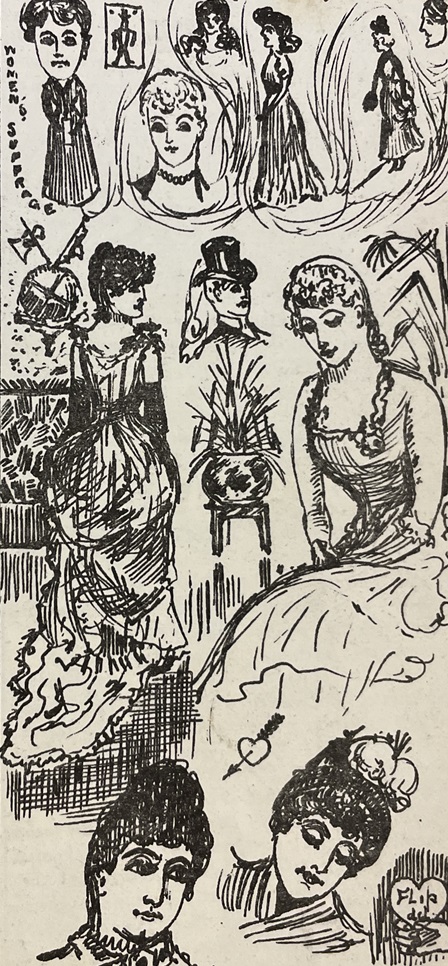
He first looks at ‘the Senseless’ young woman who ‘studies the noble science of dress, and practices it on a broad scale greatly to the detriment of her father’s bank account’ (page 22), trivialising women’s interests in the name of humour. Findlay pokes fun at the obsession surrounding marriage many young women had during this period- though arguably we can see from a modern perspective the necessity this provided to allow young women freedom from the family home.
By contrast, he perceives that for the sensible young lady ‘matrimony is possibly, her object too, but only as a contingent possibility’. This curious comparison between young women seems, as in almost every entry in The Magnet, a satirical take on late 19th century life in Glasgow.
A note on “Flip”
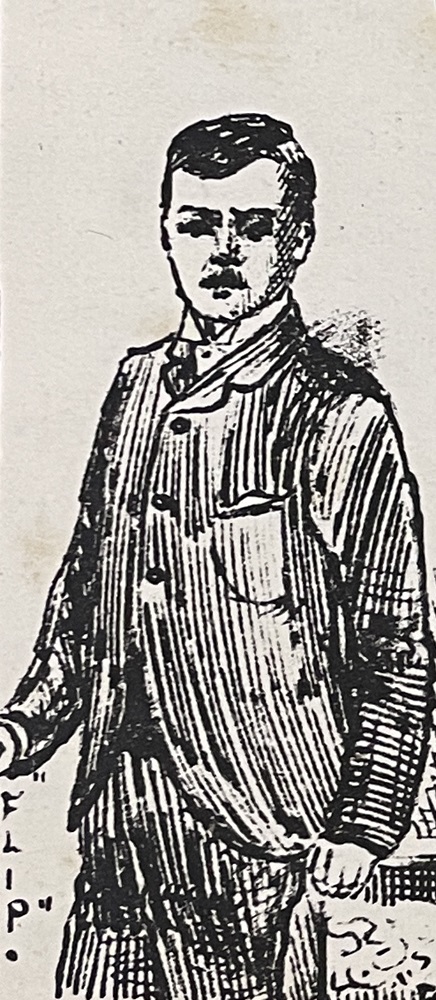
Flip is the leading illustrator for the journal, providing the majority of the witty sketches that accompany the pieces. His work conveys the beneficial relationship between illustration and text to generate further comedy. The sketches often have puns alongside, indicating how the sketches themselves are humorous in many cases, not just in assistance to the text.
Various pieces of creative writing
A String of Mottoes
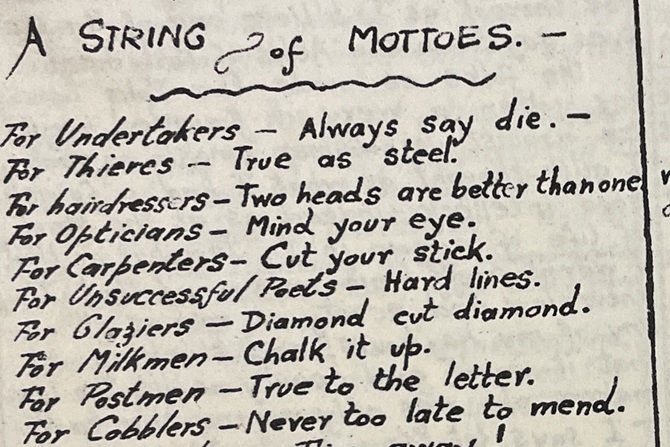
This short piece, presumably written by the editor ‘Timothy Radlowe’ (actually James Findlay III), gives a humorous list of common platitudes that have been twisted in some way to attach them to various professions. ‘A String of Mottoes’ does not have a name attached to it but the editor’s involvement is presumed due to the journal itself having a similar comedic motto written on the cover of three of the parts: ‘The Magnet is that which has attractive properties. —Definition’. An editorial also on page 8 suggests that this motto acts as a kind of expectation for the journal’s contents and hopes that the ‘attractive properties’ have been achieved.
The cigarette
The fourth part of The Magnet features a combination of prose and poetry by J. W. Breslin that is reverential in its depiction of smoking cigarettes. The piece begins hyperbolically as it suggests that smoking is equal to ‘what bliss the poets feign’ in their romantic verses. Breslin refers to smoking tobacco as being a part of ‘the true faith’ and suggests that cigarettes are the god to which we should bow.
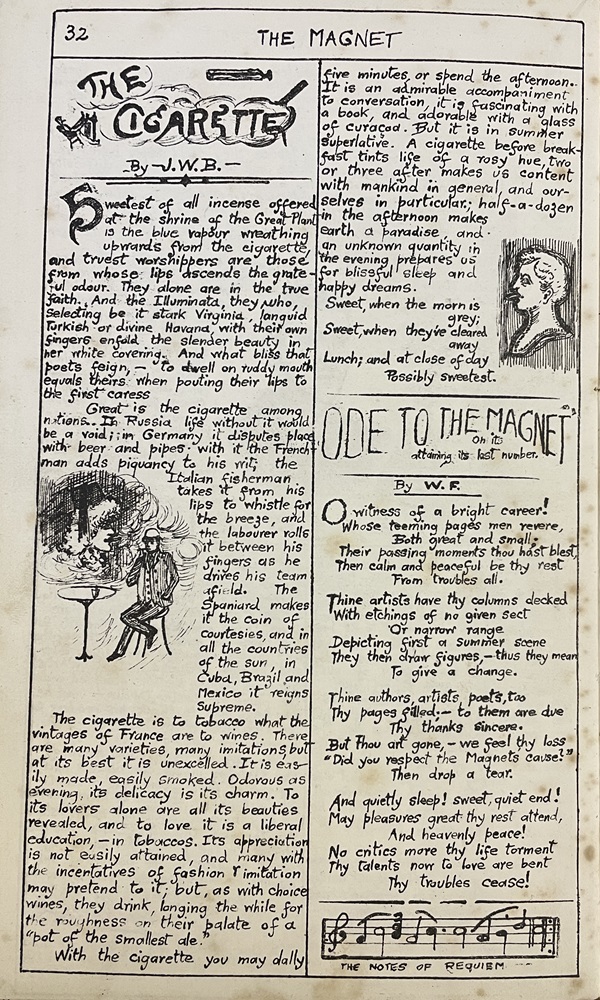
Following this, Breslin considers the cultural importance of the cigarette globally before lessening the romantic tone and grounding his appreciation in his everyday life. He makes clear how a cigarette improves the mundanities of life and expresses this in a short verse.
Ode to The Magnet on its attaining its last number
Sharing a page with ‘The Cigarette’, William Findlay has included a sarcastic, formal poem which exaggerates the public’s response to The Magnet and their supposed upset at its ending. A stark contrast is created in the midst of the sarcastic lyrics as Findlay takes a moment to genuinely thank the ‘thine authors, artists, poets, too’ who contributed their creations to the journal. The final stanza of this ode signifies an end to the journal in the form of a heartfelt goodbye as Findlay wishes The Magnet ‘heavenly peace’. To further the notion of this being a farewell, the foot of the page features the sheet music for ‘The Notes of Requiem’, solidifying this poem as a funeral composition.
The Journal as Satire
The overall tone of Radlowe’s editorial in each part comes across with great wit and playfulness as he thanks his contributors for being such great ‘humorists’. He surrounds his editorials with a series of ‘jumblings’ which seem to be a chaotic selection of puns and short anecdotal jokes. This includes pieces such as ‘A String of Mottoes,’ discussed above, as well as deadpan warnings including advice ‘to those about to marry — Don’t.’ One of my favourites of the jumblings defines ‘laughter’ as ‘the sound one hears when his hat goes flying down the street on a windy day,’ another asks for ‘the names of addresses of all ladies and gentlemen about to make their wills’ in order to convince them of the author’s ‘suitability for the post of sole legatee.’
The concept of the writers using only their pseudonyms is amusing in itself; when Radlowe reveals each of these ‘noms de plume’ in his final editorial it seems as though the writers have used their pseudonyms to take on a comical persona each with alliterative or rhyming nicknames.
A sense of the humorous tone is also apparent in all of the sketches which surround the writing. ‘Exhibition Fancies,’ for example is a supplement for part 3 of the journal and ridicules the stereotypical characters likely to be seen at the Glasgow Exhibition. The Glasgow Exhibition of 1888 showcased art, science and industry over a period of six months attracting nearly 6 million visitors from all over the world. The Magnet references the exhibition on a few occasions; here mocking the pretentious attendees who sit in gondolas on the Kelvin and brag about their ‘wife at the coast don’t ye know.’
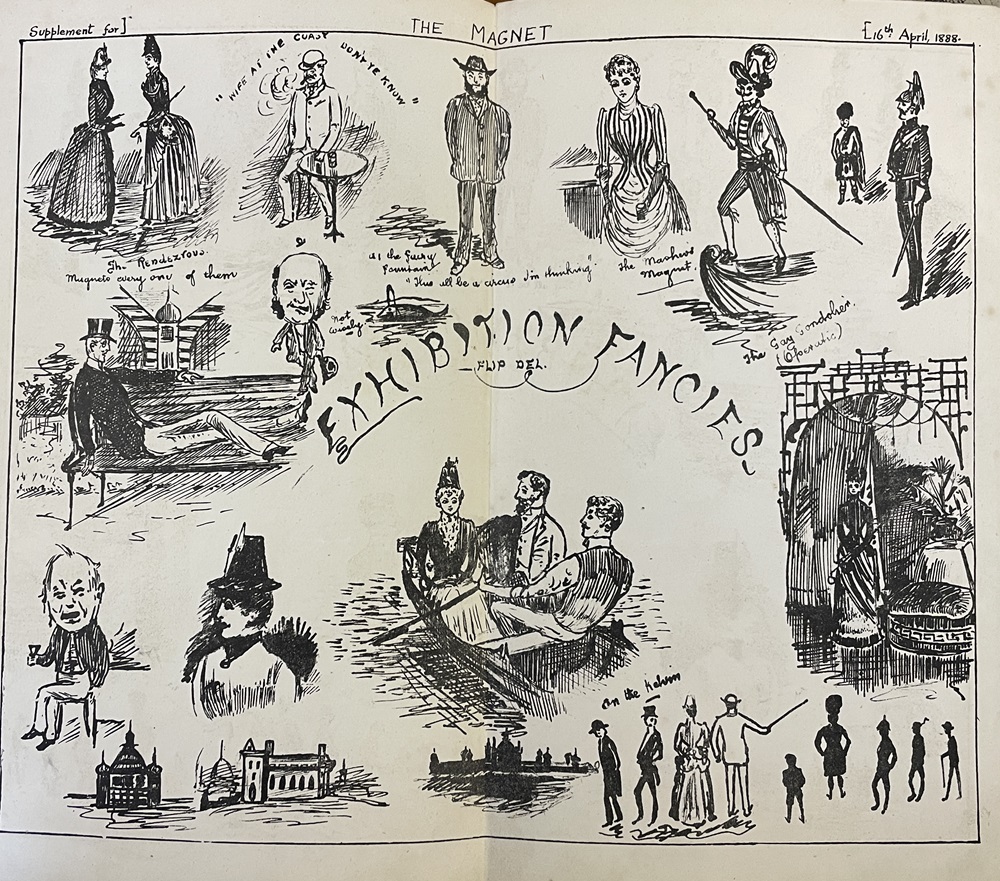
These caricatures are accompanied by an ‘Ode to the Exhibition’ which apologises in its heading to Alfred, Lord Tennyson for any insult that this ode may have on ‘The Charge of the Light Brigade,’ the poem of which it parodies.
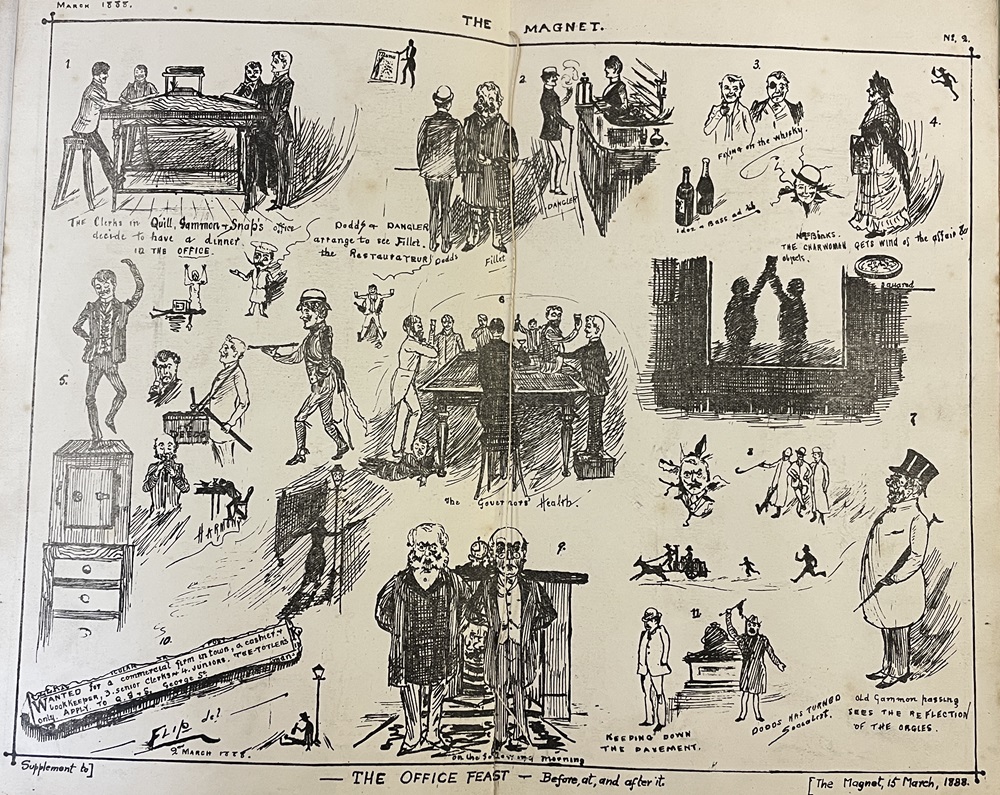
Another artist’s supplement is included in part 2 telling the story of ‘The Office Feast: Before, at, and after it.’ The comic-strip-like page ridicules those who are likely to get carried away with their drink and end the night by dancing on top of furniture. Two enraged men stand at the bottom of the page advertising for new senior clerks, ‘tee-totlers only.’
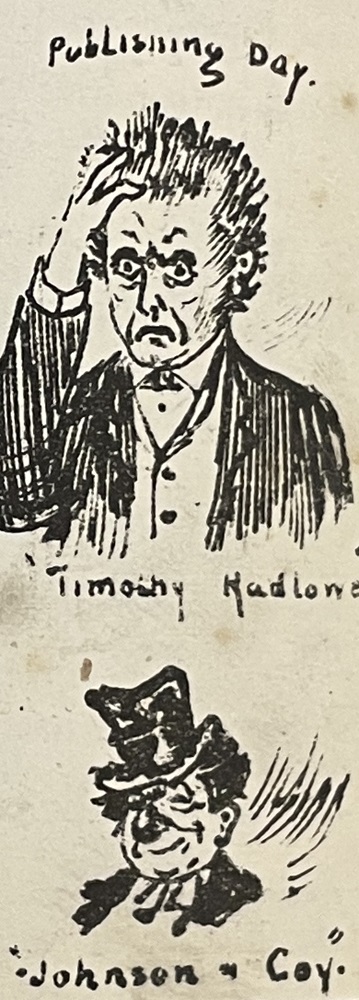
In Radlowe’s final editorial in part 4, he includes portraits of ‘Our Contributors’ which are all earnest illustrations except for two. One of which depicts Radlowe frazzled and anxious on ‘publishing day,’ and the other, which he describes as a ‘purely imaginary’ portrait of ‘Johnson & Co’ publishers, looking pompous and aristocratic, chuffed with his sales.
Overall, The Magnet, with its comedic sketches, caricatures and parodies is a humorous publication that made us wonder about its purpose. We joked about the men who wrote it simply being a group of friends looking for a laugh, yet since we could find very little record of their names in any archives this remains to be a mystery.