
by Emma Lynne Harley, playwright
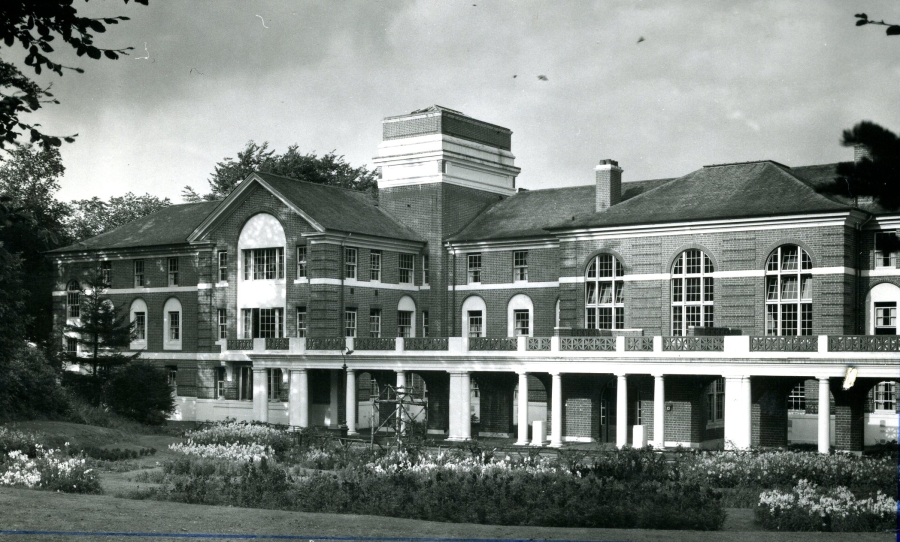
RCPSG/52/19/5/60
Over the past few years, I’ve been writing a musical inspired by Mearnskirk Hospital. A question I’ve encountered a few times has been “why Mearnskirk?” Which is really fair enough – I’m an East-coaster who moved West just as Mearnskirk House – the last remaining piece of what was Mearnskirk Hospital – closed its doors.
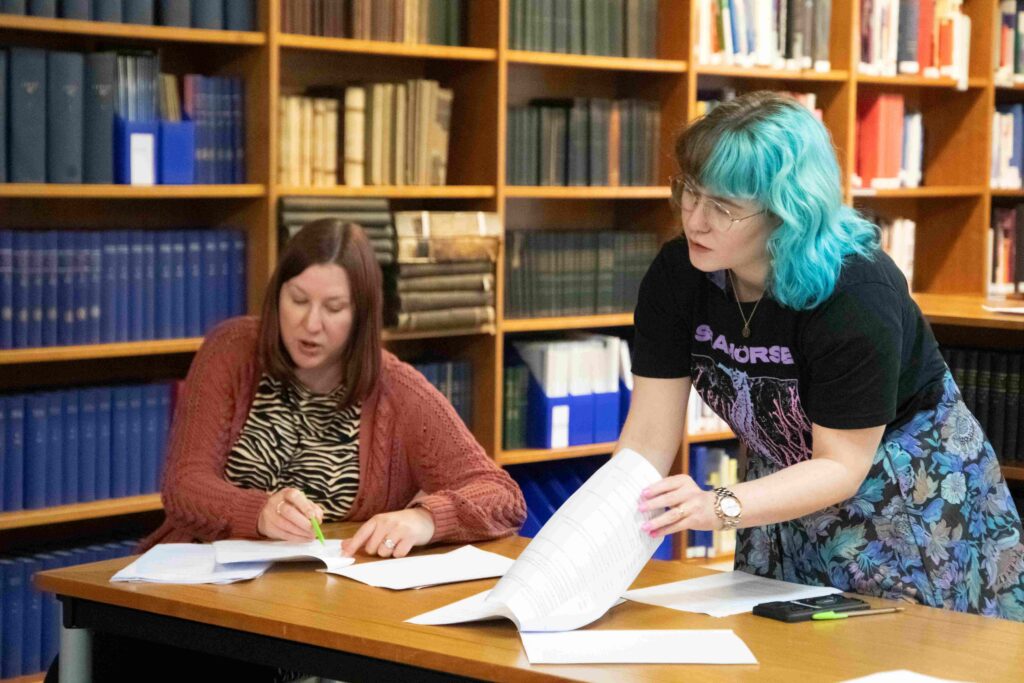
I first encountered the Royal College of Physicians and Surgeons of Glasgow as a writer with “The Prescription,” a curated creative writing group working towards the production of an anthology inspired by the College’s extensive archives. Out of the range of writing skills represented by The Prescription, I was the sole playwright.
Outside of theatres, I’d never much felt at home in grand buildings, and the Royal College is GRAND. Upon arrival, the newly assembled Prescription group took the tartan-carpet-clad path, underneath chandeliers, past a large portrait hung hall up to the library. So of course, when the collection laid out by the heritage team included theatre programmes and song lyrics belonging to the former Mearnskirk Hospital, I instantly felt a connection that put me more at ease.
Credit: Sooz Aitken
The Mearnskirk Collection tells a story of a hospital that held that same sentiment of transforming something unfamiliar into an unthreatening and warm place. Mearnskirk opened its doors as a children’s tuberculosis hospital in 1930, and due to available treatments at the time, many of these children were residents for long swathes of time. Life there for the staff and the patients emphasised quality of life, not simply medical preservation. Hundreds of pieces of evidence detail how loved and full of life the hospital was, ranging from pictures of the gardener and his dog, trainee nurses, celebrity visits, school lessons, Peter Pan statue unveilings, and playground openings; and then later, newspaper articles expressing multi-faceted outrage when the hospital was shrunk and sold off to make way for a public-private elderly unit, before its ultimate closure.
To discover a place that seemed to embody complete care, and then immediately experience its loss through a series of newspaper clippings, left me similarly outraged. I’d witnessed a birth, a life, and a death of a once state-of-the-art hospital all without leaving the library. How could this have been allowed to happen? The tale of Mearnskirk felt so much bigger than the story of one hospital in East Renfrewshire – it is a symbol of our highest and lowest points of healthcare in this country. It seemed to me that Mearnskirk perhaps even unknowingly became a blueprint for what is being done to our NHS on a huge scale now. I knew I had to write about it.
There are certain responsibilities when it comes to writing about something real in a fictional manner, and they don’t always get on. Writing for the stage in any way has first and foremost got to be entertaining. Writing from a place of fact has to relent to this rule and sometimes, events have to be compiled in ways that make more sense to a viewer, even if in reality, these events were much more convoluted and drawn-out. Life is messy and often doesn’t translate neatly into a digestible chunk for audience consumption, especially if you give yourself the task of setting the action across 70 years of change, with a maximum run time of 2 hours and 30 minutes (interval included).
The responsibility grows in complexity the more “real” things are kept – for example, real people and their stories require that you represent them with some semblance of faith to their original character. If faithful to everything real all at once, it would be easy to fall into the trap of making a slightly wooden and half-imagined live documentary which does neither theatre nor documentary justice. Theatre by nature should be theatrical, and there was a lot of theatricality to be found to pull me out when I did find myself stumbling into that trap: the possibilities Mearnskirk’s Peter Pan statue creates, the drama of the closure protests, and the way the hospital aged alongside the patients it treated.
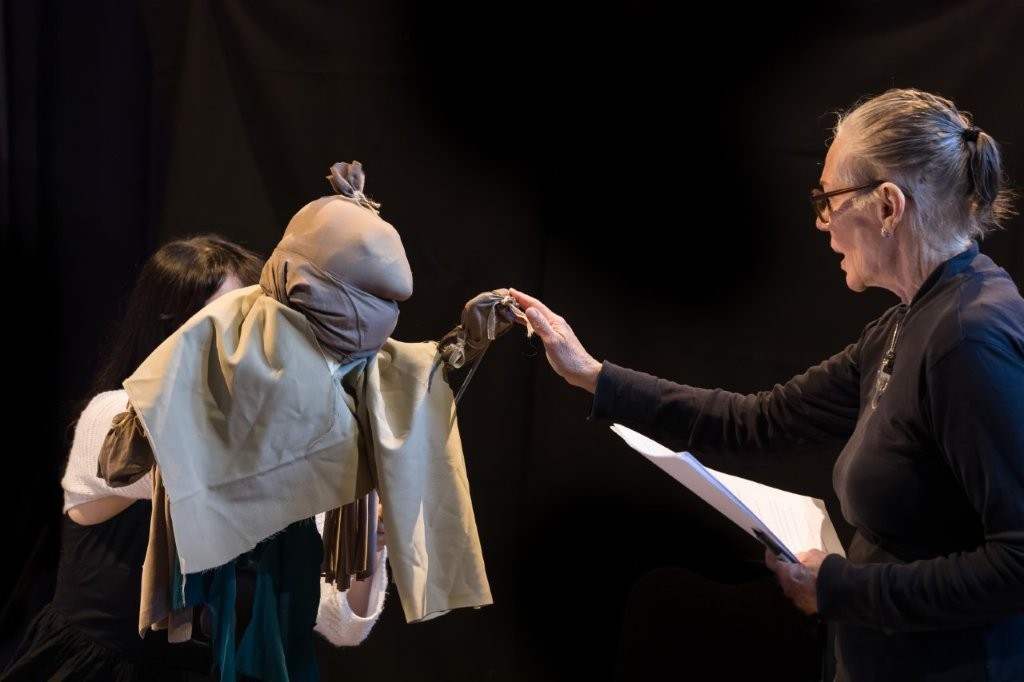
I made the decision early on to be most faithful to the real things that had given me the connection I’d initially made with the archive material – the way the hospital had changed over the years as an allegory for the jeopardy the NHS faces today. The span of time, difficult as it is to work with, was important. The perspective of a life lived in parallel with the hospital is told through the first character that appeared in my mind: Wendy McKelvie, or “Nana”, an 80-year old woman who knows the magic of Mearnskirk several times over.
Credit: Sarah Darling
Nana’s journey came first for me and her world has grown, informed by the timeline structure of what happened to Mearnskirk pieced together from the RCPSG archives. How’s this for a synopsis?
Wendy McKelvie has spent her life in hospital – and so has the disembodied Shadow of Peter Pan.
A chance meeting in a children’s ward sees Shadow follow Wendy back to the hospital that saved her life, to work as a nurse, with a family of her own. As Wendy grows up, the hospital ages too – and something’s not right. There are wagers being set about green tights, the porters are on strike, and there are mysterious back-room deals rumoured in the paper. If this land really is magic, why is it unable to save itself? What secrets is Wendy’s daughter keeping? And will Peter Pan ever return for his Shadow?
I’ll leave it up to you to decide which bits were based on factual happenings I found through the archive.
Okay – I’ll give you one. The mysterious back-room deals. There are reports across several years about Mearnskirk’s closure (the first of which was retracted as a mistake), sale (or sales plural), the announcement of a new NHS facility, and the subsequent failure of the money promised to build said NHS facility to arrive. It took a long time to unpick some of these threads so that I could realistically set my characters against the action. There are some historical knots of goings-on that are still entangled in secrecy that not even Freedom of Information requests and the purchasing of many a title-deed can unpick. So far…
When I first engaged in the Royal College archives, I was an archive novice and relied heavily on the generous help of Clare and Claire of the heritage team. As time has progressed, and I’ve developed the script and my research more deeply and further afield, I can ask for assistance less and less, and have unwittingly become more well-versed in the complete history of Mearnskirk Hospital than anyone else I’ve encountered thus far. Which is a terrifying and surprising pedestal to find myself on, so I’d be delighted if somebody who knows more about how events unfolded can come along and take their rightful place – so that they can correct me on anything I may have gotten wrong, preferably before the show opens.
The show is under a working title of “Cradle to Grave”, with music by Bethany Tennick and directed by Beth Morton. A free work-in-progress sharing will be accompanied by a discussion with tea and cake at 2pm on Friday 6 November at Eastwood Theatre. All are welcome, with an age guidance of 14+.
Book here: https://www.enjoyeastren.org/events/mearns-kirk-project-from-cradle-to-grave/
To quench the pedant’s thirst for some historical accuracy despite the playwright’s remit for entertainment, I have also created an exhibition on Mearnskirk Hospital (using some of the Royal College’s Mearnskirk archive) that will be displayed at Eastwood Theatre from 31 October to 15 November, during regular opening hours, on the first-floor gallery space.
Lift or level access available for all events.
If you’re reading this and the event has passed, you can look at my own website to see if there’s any upcoming news! https://emmalynneharley.com/work/cradle-to-grave/