
By Tasmin Evans
Tasmin is a researcher of colonialism, empire, slavery and their legacies, and an advocate for anti-racist practice. Tasmin is committed to addressing the colonial connections between Scotland and the Caribbean. She is working with the Heritage team at The Royal College of Physicians and Surgeons of Glasgow to explore John James Audubon’s colonial world.
We are delivering two workshops in October 2026:
Beyond Audubon: Exploring the colonial world of The Birds of America.
To book:
“How often, Good Reader, have I longed to see the day on which my labours should be brought to an end,” John James Audubon wrote in the first volume of his Ornithological Biography series. It began publishing in the same year that thousands of enslaved people across Jamaica, led by Samuel Sharpe (1801-1832) took up arms for their freedom in the Baptists War of 1831-1832. Audubon’s story is well known by now, a bird enthusiast captivates the world with his survey of birds across the 19th century North American wilderness. He is the face of early American bird watching, elevated to godhood, but his deification has divorced him from the same world he existed in, contributed to and took advantage of. Surrounding Audubon is the world of colonial capitalism that sits as a footnote in his sketches, rather than as the context that places his work within space and time.
What happens if we try to reconnect Audubon with the world surrounding his famed The Birds of America? We all know by now that the vast majority of historical figures alive within the colonial 15th to 20th centuries were stepping on a few thousand toes in order to be remembered, and he was no exception. Peeking behind the curtain of his magnum opus should probably not surprise us, but it is important to engage with these contexts and explore how the past has informed the present. By taking a glimpse at the world of Audubon, we can start to unpick the deification and ask the question: does any of this matter in the 21st century? Stuck in his orbit are the stories of whiteness and racism, slavery across the Caribbean and United States, the growth of capitalism, and the growing tide of climate change that contributes to the collapse we are seeing today. What can we take from him to understand our world now?
What is there left to find out?
Audubon has countless biographies ranging from the 19th to the 21st century, recounting the same story of the boy from Saint-Domingue, now Haiti, growing up in France but moving to America, promising the world that he would record and draw every bird species in North America. They tell of a man with an insatiable love for ornithology and a righteous purpose to provide for his family, who against all odds managed to sell his book across the US and Europe, dying a famous and rich man.
There’s no need to recount that story, but what else isn’t being told and how can we tell it in a new way? They do definitely discuss the ‘difficulty’ of trying to find his stance on slavery, despite openly purchasing and selling enslaved African people at his own whim. They even talk about his cut-throat capitalist nature and his drive to step on any rivals, most particularly Alexander Wilson (1766-1813), the Scottish-American ornithologist who hoped to publish a similar piece of illustrative work. Perhaps, though, there are other perspectives that are missing from the story.
The Birds of America reflects the all too famous theory that science only exists when written by the white European. How many bird watchers, ornithologists and naturalists already knew and named these birds before Jean Jacques Rabin – his name before becoming naturalised as John James Audubon – was ever born? How many indigenous people were present for his study, taught him the best places to hunt, the best paths to take and the best ways to traverse the wilderness? Who were the people that he so flippantly bought and sold to make a quick buck when his businesses were failing?
Time has passed, Audubon is nearly two centuries dead and his work has already been picked at by everyone. But in many ways, these books will always be revered, the way that they still capture the minds of modern bird specialists, artists and people around the world shows that enough. The books, once held by various hands for various means, now sit in controlled storage, brought out only when necessary and handled with reverence. Is it possible to speak the truth to this god? If the world behind The Birds of America was originally silent, how can we speak to it?
Anti-colonial approaches to interpreting Audubon
Over recent years, the history of science has been spotlighted in the decolonisation conversation. Most notable is the 2018 paper by Subhadra Das and Miranda Lowe ‘Nature read in black and white,’ which called for an end to the myth that science was neutral, especially in heritage spaces. By peeking through the gaps of historical accounts and asking ‘what if’ about our objects, we can start to find new perspectives
For Audubon, his story is rich with rabbit holes. His upbringing in Haiti shortly before its 1791 revolution, the erasure of his mother’s existence, and his proximity to the slavery system – that’s only the first few years of his life! More prodding into his time working on The Birds of America shows a man desperate to be famous, and willing to do anything to get there.
One great example is the now defunct Bird of Washington, Falco washingtonii, which Audubon claimed to have seen a few times in the wild, but no one has ever seen since. He described it as being almost identical to the bald eagle, apart from a few hunting differences, but this mysterious bird baffled ornithologists. Audubon had shot and killed most of his birds before drawing them, picking through piles of corpses to find the best ones and posing them using his own memory of their activities. By the time he drew this specimen, he may have forgotten much about it or, more likely, his amateur skills as an ornithologist and readiness to discover new species led him to believe he was looking at something new. Less than 50 years after his death, in 1882, scientists concluded that he must have been looking at a juvenile, or baby, white eagle.
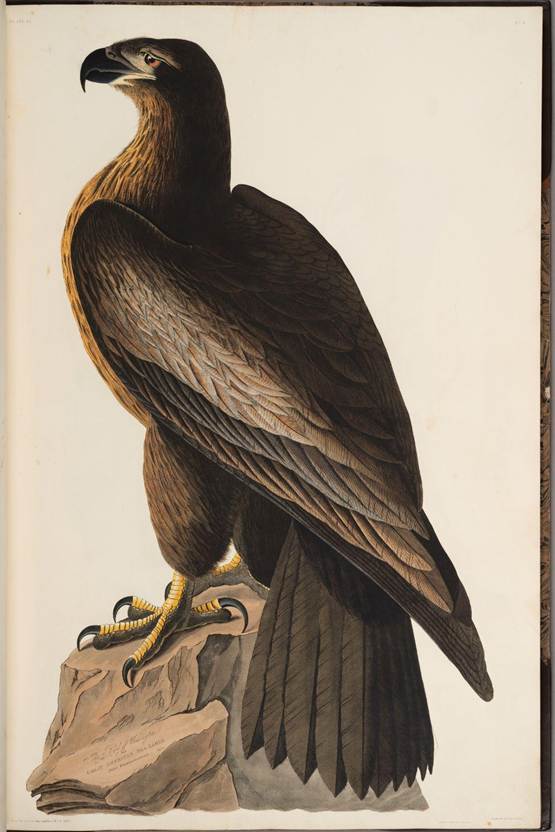
The Bird of Washington, Volume 1, Plate 11
But simply researching these things is only one step into anti-colonial thinking. Anti-colonialism is the term used for rejecting colonial, imperial and Western ideas that dominate our world. To be anti-colonial, research must also be understood as not neutral. Giving power to people whose stories were deliberately silenced in history is the first step to challenging this. Rather than one person presenting weeks, months and years of research to an audience of listeners, knowledge and meaning can be generated through conversations and collective reasoning. To understand what place Audubon and his massive books have in the modern day, we should be talking to others, engaging with each other to see where we stand with him and what he represents about our current world.
Look back at the story of the eagle. How does that make you feel? What are your interpretations of Audubon based on that story? Does it reflect something about our own current society?
This Black History Month, we will be asking these questions of John James Audubon and the stories that surround him in an attempt to peek through the gaps of his legacy. Through a series of workshops, we hope to use human-based practices to understand The Birds of America through a new lens and explore how conversation can be used as a method of research and knowledge generation.
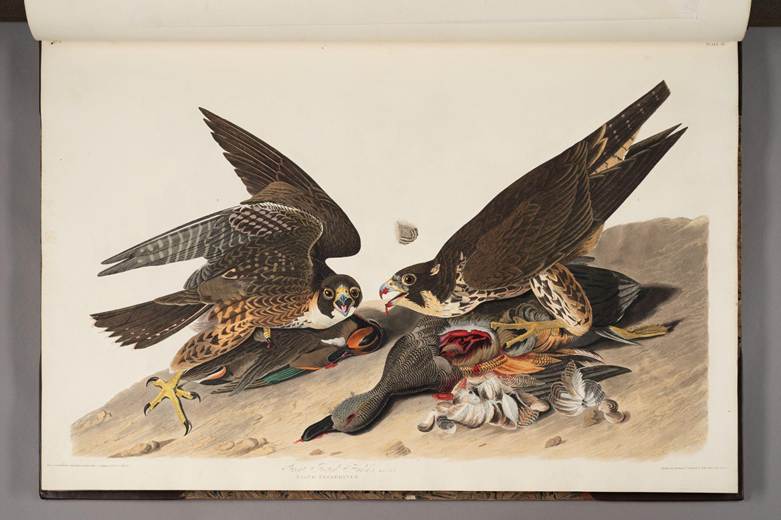
Great-footed hawks, Volume 1, Plate 16
The Royal College of Physicians and Surgeons of Glasgow purchased volumes one and two of the first edition of John James Audubon’s The Birds of America in 1838. A new exhibition exploring these world famous books is on display in the College Library and can be visited every Monday (except for Bank Holidays) between 2pm and 5pm. Please email library@rcpsg.ac.uk if you would like to arrange to visit on a different date. https://heritage.rcpsg.ac.uk/exhibits/show/audubon-birdsofamerica